June 28, 2026
The Literacy Ecosystem: 4 Types of Reading Assessment
Understanding the four distinct types of reading assessment is the only way to move past surface-level data and target exact student needs.
To break the cycle of reading failure, we need to look at literacy through a clinical lens. A comprehensive reading ecosystem requires four distinct types of assessments, each serving a unique, non-overlapping purpose.
For a long time, I personally found it difficult to truly understand and differentiate between the four types of assessments. Everything changed when someone finally explained it to me using the medical model. Once I compared the data we use in schools to what I experience every time I walk into a doctor’s office, it finally clicked.
Let’s look at each through that medical model lens to help it click for your team.
1. Universal Screeners (Who needs help?)
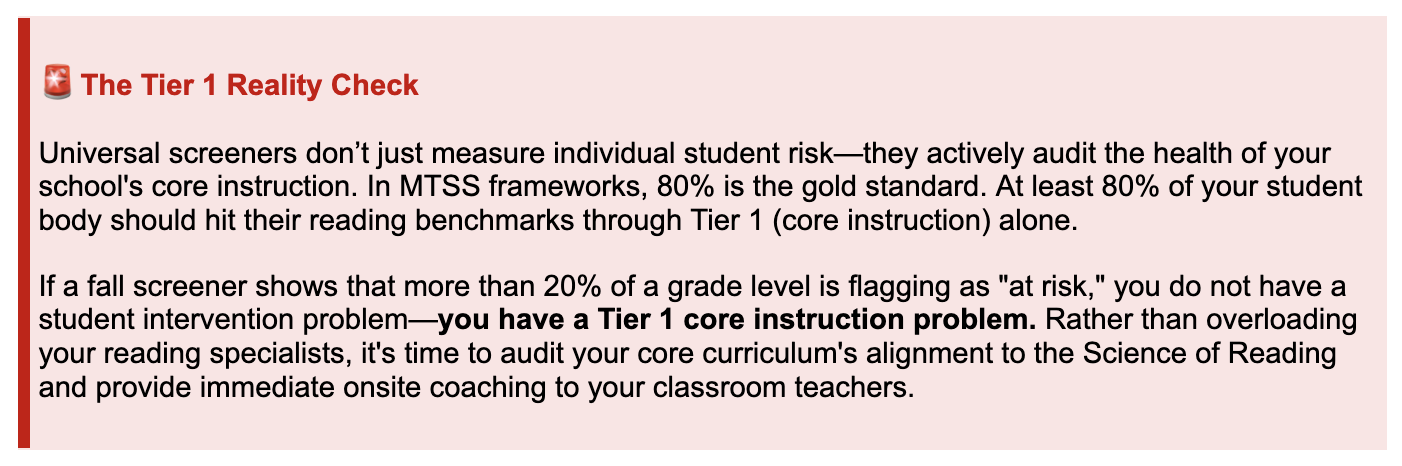
Brief, timed, norm-referenced tools administered three times a year (Fall, Winter, Spring) to the entire student body (examples of reading screeners include Acadience, DIBELS, iReady Reading, and STAR Reading).

- The Medical Analogy: The nurse checking your vitals (blood pressure, temperature, weight) at an annual physical. They are fast, non-invasive, and universal. They flag if something is statistically "off," but they cannot tell you why. A thermometer tracks a fever, but it cannot distinguish between a common cold, the flu, or an acute infection. Screeners sound the alarm, but they cannot diagnose.
2. Diagnostics (What Help Do They Need?)
Untimed, granular, criterion-referenced assessments administered specifically to the sub-group of students flagged by the screener.
- The Medical Analogy: The specific laboratory blood work or X-ray ordered after a flag is found during your vitals check. They dive deep into specific skill breakdowns to isolate the exact root cause to form an accurate, effective treatment plan.
3. Progress Monitoring (Is the Help Helping?)
Quick, highly frequent checks on the specific micro-skills currently being targeted in intervention.
- The Medical Analogy: Checking a patient's blood pressure weekly to see if a newly prescribed medication is safely working. It provides real-time adjustments before waiting for a major benchmark period.
4. Outcome Assessments (Did They Master Learning Objectives?)
Summative evaluations at the end of a learning cycle (ranging from classroom unit tests to high-stakes state standardized testing).
- The Medical Analogy: A final clearance exam at the end of a treatment cycle to verify total recovery. While they evaluate macro-level system health and accountability, they happen after the learning window has closed and provide little to no actionable data for daily classroom instruction.
🚀 The Next Step for Your School
Recognizing that your universal screener has a diagnostic blindspot is step one. But how do you actually bridge the divide between high-level screeners and deep diagnostics—trading instructional guesswork for total data precision?
That is exactly where Root Compass comes in. Built as the missing "clinical lens" for your MTSS framework, it bypasses the guessing strategies of clever compensators to uncover hidden decoding deficits.
In Part 3 of this series, we break down exactly how screeners and diagnostics work hand-in-hand to transform your RTI model into an empirical science:
👉 Read Part 3: Fixing the RTI Gap with Diagnostic Precision(Or, if you are ready to see the platform in action today, you can Schedule a complimentary consultation or demo today.
📚 Further Reading & Research
1. The Core Research (The "Decoding Threshold"):
- The Decoding Threshold Report (AERDF & ETS): The Decoding Threshold: Measuring the Roots of Older Students' Reading Difficulties. This is the definitive study cited in this post, revealing why comprehension stalls when advanced foundational decoding is ignored.
- Reading Reimagined Initiative: Explore the ongoing research and systemic findings from the Advanced Education Research and Development Fund (AERDF) regarding the "Older Student Literacy Gap."
2. Systemic MTSS & Tier 1 Auditing Tools:
- The Reading League Curriculum Evaluation Guidelines: The gold-standard tool for school leaders to audit their current Tier 1 core reading curriculum and ensure absolute alignment with the Science of Reading.
- National Center on Intensive Intervention (NCII): Access free data-meeting protocols, intervention fidelity checklists, and screening charts to help your school manage a healthy, proactive MTSS framework.
About the Author

Heather Ballantine, M.A. | Literacy Specialist & Educational Entrepreneur
Heather has spent over a decade in education as a secondary teacher, reading specialist, and literacy consultant. As the Founder and CEO of Root Literacy Design and Co-Founder of Root Compass, she is a boots-on-the-ground practitioner dedicated to ensuring all students learn to read and write. She specializes in creating evidence-aligned tools and coaching educators to turn data into actionable instruction.